| Stay healthy with Resveratrol Co. |
| |
Life Extension :
Perhaps the most exciting research being conducted on resveratrol is occurring within the realm of life extension.
Researchers have determined that resveratrol has the ability to extend the lives of yeast, worms, fruit flies, a certain species of fish, and obese mice up to 70%, 29%, 24%, 50%, and 31% respectively (depending on the amount of resveratrol given). Whether these results will transfer to humans is not known.
So how does resveratrol extend life in certain organisms?
The exact answer is not known but a widely asserted theory is that Resveratrol activates an enzyme that is present in the bodies of many living organism called sirtuin 2 (or SIR2). SIR2 is believed to extend cell life by 'coercing' cells to repair themselves (i.e. repair their DNA while increasing the production of protective antioxidants) as opposed to dying. In essence, it is believed resveratrol extends the lives of individual cells and the lives of the 'host' organisms are extended as a result.
Interestingly, SIR2 is also activated by the practice of Caloric Restriction (reducing the calories in a 'normal' diet by around 40% while still consuming the necessary vitamins and minerals a body need; that is, replacing high calorie foods with low calorie nutrient rich foods). Science has proven that calorie restriction increases the lives of organisms such as mice while significant health benefits have been observed in monkeys and humans - studies are underway to determine if calorie restriction extends the lives of monkeys and humans - many in the scientific community are optimistic that it does.
Many scientists (and those in the venture capital community) are extremely optimistic about the future of resveratrol for disease prevention, disease treatment, and life extension; researchers from institutions such as Harvard and the Massachusetts Institute of Technology (MIT) are currently developing pharmaceuticals based on the chemical structure and properties of resveratrol. It is believed that these drugs are 5 or more years away from commercial and regulatory feasibility.
Increased Endurance :
Does consuming resveratrol increase endurance? |
| |
 |
| |
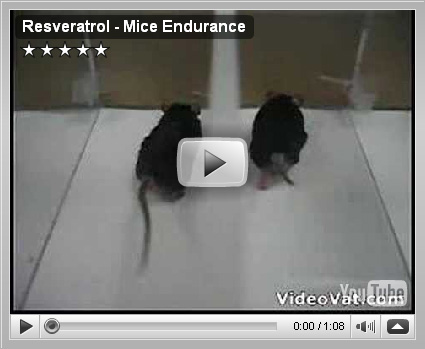
According to a study conducted by the Institute of Genetics and Molecular and Cellular Biology, mice given oral doses of resveratrol were able to run 100% farther than mice not given the resveratrol. The resveratrol dosed mice also displayed a reduced heart rate and energy charged muscles - physical characteristics associated with highly trained athletes. According to the study's lead scientist, Johan Auwerx, "Resveratrol makes you look like a trained athlete without the training".
Will these results translate in to humans?
According to Mr. Auwerx, the same reaction will likely occur in humans based on his analysis of the gene that is influenced by resveratrol in a group of Finnish subjects.
What could be causing the increased endurance?
According to Mr. Auwerx, resveratrol alters muscle fibers to make them more like muscle fibers of a trained athlete.
Another exciting result from the study!
Resveratrol significantly increased the number of mitochondria in the muscles cells of the mice (mitochondria are responsible for generating cells' energy). The increased mitochondria allowed the mice to burn more calories and thus avoid weight gain. The mice also did not experience decreased sensitivity to insulin (a symptom of being overweight and a cause of diabetes). |
| |
Weight Loss:
In November of 2007 a study was published in the journal Cell in which it was revealed that resveratrol administered orally to mice significantly increased the number of mitochondria in the mice's cells (Mitochondria are the organelles within the body's cells that generate energy).
Not only did this increase in mitochondria double the mice's endurance, but it also increased the mice's metabolism; In essence, with increased mitochondria levels, the mice were able to burn more calories, and thus avoid weight gain.
A lead researcher of the study, Johan Auwerx, said a study of men and women from Finland revealed that resveratrol will likely produce similar results in humans. |
| |
Diabetes Control :
Perhaps the most imminent breakthrough for resveratrol will be for the treatment of type 2 diabetes.
In January of 2008 Sirtris Pharmaceuticals announced that its version of Resveratrol "significantly" lowered glucose (in an oral glucose tolerance test) in HUMANS with Type 2 diabetes. Doses of 2.5 or 5 grams were administered orally once a day for 28 days. The patients experienced "no serious adverse events and no dose related adverse events" - in other words, Resveratrol was well tolerated by the patients.
This study is significant because it shows that Resveratrol might well be used to treat type 2 diabetes in the near future and that it seems to be well tolerated by patients at large doses (2.5 to 5 grams per day). Smaller doses might have the same beneficial effects as indicated by an October study where the equivalent of 15 mg. of Resveratrol effectively increased insulin sensitivity in diabetic mice.......
In July 2007, Sirtris Pharmaceuticals announced that its version of resveratrol reduced glucose and improved insulin sensitivity in multiple pre-clinical models of Type 2 Diabetes.
The results of this Sirtris study were no surprise however. In November 2007, a study was released in the publication Cell that indicated that resveratrol administered orally to mice protected them from gaining weight and developing diabetes. A lead researcher of the study, Johan Auwerx, said a study of men and women from Finland revealed that resveratrol will likely produce similar results in humans.
It is possible that resveratrol fights diabetes in two ways; by reducing glucose and improving insulin sensitivity and by increasing animals' metabolisms (thereby decreasing weight gain - a main contributor of type 2 diabetes). See 'Weight Loss' page.
Sirtis is currently performing a Phase 1b resveratrol study in human patients with Type 2 Diabetes. The results of this study will be released in the second half of 2007. |
| |
Heart Health:
Several studies indicate that consuming resveratrol may help protect the human heart. There are several reasons why this may be true. |
| |
Anti-Inflammatory :
Inflammation is the natural process by which the body responds to injury (such injury may be caused or exacerbated by bacterial infections or a viruses). Numerous studies suggest that inflammation is a contributing factor in fatty deposits building up in the lining of arteries (also known as atherosclerosis). These fatty deposits can clog arteries and cause heart attacks or stokes.
Resveratrol has been found to inhibit the activity of several inflammatory enzymes (in vitro) in several laboratory studies. |
| |
Blood Platelet Aggregation :
Blood platelets are irregularly shaped cell fragments that help to form blood clots; blood clots can partially or fully block coronary or cerebral arteries causing heart attacks or strokes.
Several studies indicate that resveratrol inhibits blood platelets from aggregating (in vitro). |
| |
Lowering Cholesterol :
Many researchers believe that resveratrol is at least partially responsible for the cholesterol lowering effects (both total cholesterol and LDL cholesterol) of red wine. Resveratrol is believed to block cholesterol oxidation through its antioxidant properties.
Treatment After Heart Attack
5 to 10% of heart attack victims suffer a condition called atrial fibrillation (where the top chambers of the heart flutter) after a heart attack; this condition can produce blood clots that can result in a stroke. In a recent study, resveratrol was given to selected rodents before a heart attack was induced while other rodents received nothing. The mortality rate of rodents who received the resveratrol was just 10% and fibrillation lasted an average of 112 seconds compared to a 50% mortality rate and fibrillation lasting an average of 164 seconds for rodents who received no resveratrol. |
| |
Cancer Prevention:
Resveratrol has been proven to fight cancer in vitro at all three stages; (1) initiation, (2) promotion, (&) progression.
Resveratrol is a powerful antioxidant that can help prevent cell damage caused by free radicals. Damaged cells are more likely to become cancerous than healthy cells.
Resveratrol has been proven to induce cancer cells to die in a preferable (i.e. normal) manner (like healthy cells die in their natural life cycle). Whereas radiation and chemotherapy cause cancer cells to break open and release their contents into the body, creating inflammation in neighboring cells, resveratrol induces white blood cells to consume the cellular debris of the cancer cell after its death (this process is called apoptosis).
Skin Cancer - Several studies have shown that Resveratrol applied to the skin of hairless mice before exposure to solar (UVB) radiation helped to prevent skin tumors. Interestingly, Resveratrol applied to the skin of hairless mice after exposure to solar (UVB) radiation produced the same results. Might resveratrol one day be used to prevent/treat skin cancer? |
| |
Alzheimers Prevention:
Recent studies suggest that resveratrol might help prevent or ameliorate alzheimers disease.
One of the characteristics of alzheimers disease is the deposition of plaques in the brain. These plaques are caused by amyloid-beta peptides. Recent scientific studies suggest that adding resveratrol to the cells that create amyloid-beta peptides (and as a result the destructive plaques) result in significantly lower levels of the amyloid-beta peptides in these cells.
If taken orally, could resveratrol effectively treat the brain? Science has not conclusively answered this question. However, one recent study concluded that resveratrol has the ability to pass through the blood-brain barrier (blood vessel walls that prevent many toxins and other compounds -potentially good and bad - from entering the brain). In essence, resveratrol has the ability to reach, and perhaps, treat the brain.
Additionally, studies have indicated that people who drink red wine are less likely to be affected by alzheimers. |
|
|
 |
|
| |
|
|